
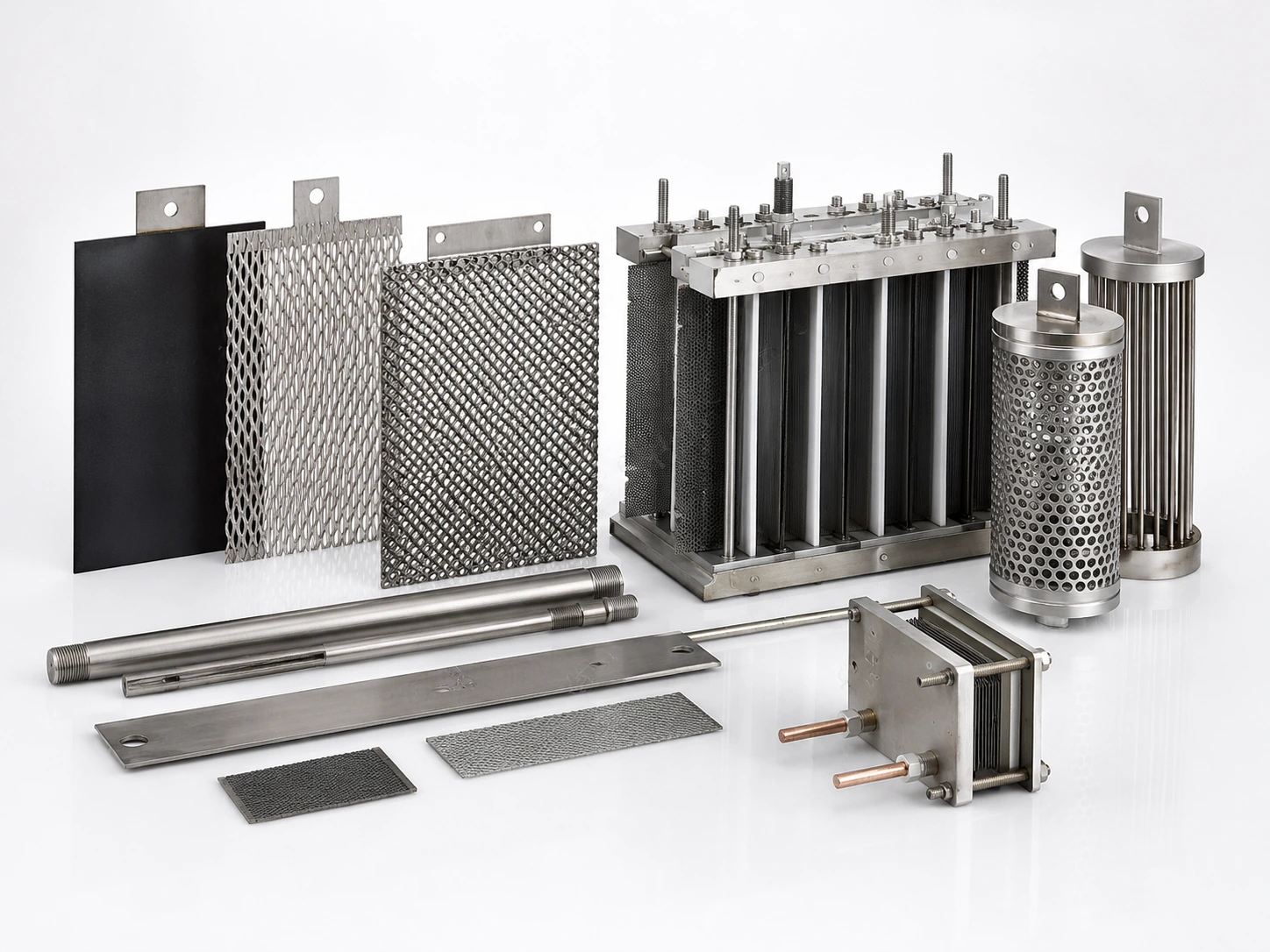
MMO titanium anodes are widely used in industrial electrochemical systems because the titanium substrate provides dimensional stability while the mixed metal oxide coating is designed for the target electrochemical reaction. In practice, however, an MMO anode is not selected only by shape or catalogue name. A plate, mesh, ribbon, tubular anode or canister anode can look simple, but the suitable coating system and structure depend on the operating environment.
Start from the application and anode role
The first question is the process objective. A wastewater oxidation project, a seawater electro-chlorination unit, a cathodic protection system and an electrowinning cell may all use titanium-based anodes, while each application typically calls for its own coating direction and mechanical design. The medium, target reaction, chloride content, acidity or alkalinity, temperature and by-product tolerance should be reviewed together before a specification is fixed.
For example, a chlorine-evolution application and an oxygen-evolution application place different demands on the coating. A project involving high chloride concentration, fluctuating water quality or frequent start-stop operation also needs a different discussion from a stable laboratory test. Early clarification reduces the risk of choosing an electrode that fits the drawing but not the process.
Key operating data to confirm
- Electrolyte or water chemistry: main salts, chloride level, pH, conductivity, impurities and possible scaling components.
- Electrical conditions: operating current, current density range, voltage limitation, DC power interface and duty cycle.
- Thermal and hydraulic conditions: temperature, flow pattern, pressure and whether the anode is exposed to stagnant, turbulent or mixed conditions.
- Mechanical interface: plate size, mesh opening, tube length, connection position, busbar layout, sealing space and installation method.
- Operating expectation: continuous or batch operation, maintenance interval, target service life and replacement plan.
Geometry should match both process and installation
Many selection errors come from treating geometry as a separate drawing issue. In fact, electrode geometry affects current distribution, pressure drop, gas release, scale deposition and ease of maintenance. A compact plate may be convenient for installation but unsuitable if flow distribution is poor. A mesh may improve mass transfer in some conditions but requires careful attention to mechanical support and electrical connection. Ribbon or tubular anodes can be useful in cathodic protection or special installation spaces, while cell-type applications may require a more integrated discussion.
For replacement projects, photos and drawings of the original anode, busbar, fasteners and cell space are extremely useful. For new projects, it is better to share the cell layout or process concept first, even if the design is still preliminary. This allows the engineering team to review whether the requested electrode shape is consistent with the electrochemical purpose.
Documentation and proposal scope
A clear RFQ should also state what documents are needed: quotation drawing, material description, coating direction, inspection report, packaging requirement, certificate request or installation note. For industrial projects, the most useful proposal includes the unit price together with the basis of selection, supply boundary and assumptions used for review.
TJNE usually reviews MMO titanium anode enquiries by combining application data, operating conditions, interface requirements and expected documentation. The goal is to provide an anode configuration that fits the process and the equipment boundary, rather than simply matching a generic product name.